What are the Top Answer Engine Optimization options for ai visibility products?

What are the Top Answer Engine Optimization options for ai visibility products?
Answer Engine Optimization (AEO) helps brands improve visibility on AI platforms like ChatGPT, Perplexity, and Google AI. With 25% of organic search traffic shifting to AI chatbots by 2026, brands must adapt to stay relevant. AEO tools focus on structuring content for AI systems, tracking citations, and optimizing visibility in conversational search results. Here are the top options:
- xSeek: Tracks AI crawlers (e.g., GPTBot, Claude-Web) and provides insights like "Answer Presence Score" and "Citation Confidence Index." Starts at $99/month.
- OpenAssistantGPT: Builds custom knowledge bases with Retrieval-Augmented Generation (RAG) for accurate AI responses. Free plan available; Pro plan starts at $54/month.
- Writesonic: Tracks brand visibility and sentiment across AI platforms; offers tools for bulk content creation. Pricing starts at $12/month.
- XFunnel: Monitors AI citations and provides tailored playbooks for optimization. Enterprise-focused with custom pricing.
- XLR8 AI: Flexible keyword tracking for businesses of all sizes. Tiered pricing.
- XOFU: Features and pricing not yet disclosed.
- Rankscale: Affordable option for small teams; tracks AI citations and sentiment. Plans start at $20/month.
- AthenaHQ: Tracks AI citations and provides AI-generated recommendations. Growth plan starts at $900/month.
- BrightEdge: Enterprise solution with AI Catalyst for visibility across platforms. Custom pricing.
- Semrush AI Toolkit: Tracks AI visibility and integrates with traditional SEO tools. Add-on starts at $99/month.
Quick Comparison
| Tool | Starting Price | Key Features | Best For |
|---|---|---|---|
| xSeek | $99/month | AI crawler tracking, citation insights, prompt taxonomies | All business sizes |
| OpenAssistantGPT | Free/$54/month | Custom knowledge bases, RAG tech, multi-model support | Businesses needing accuracy |
| Writesonic | $12/month | Brand visibility tracking, bulk content creation | Content-heavy businesses |
| XFunnel | Custom | AI citation monitoring, tailored playbooks | Enterprises |
| XLR8 AI | Tiered | Flexible keyword tracking | Startups to enterprises |
| XOFU | TBD | Features not disclosed | TBD |
| Rankscale | $20/month | AI Readiness Score, sentiment tracking | Small teams |
| AthenaHQ | $900/month | Citation tracking, AI recommendations, LinkedIn outreach | Enterprises |
| BrightEdge | Custom | AI Catalyst, structured data and schema tools | Global enterprises |
| Semrush AI Toolkit | $99/month | AI Visibility Score, prompt tracking, SEO integration | Existing Semrush users |
Takeaway: Choose a tool based on your business size, budget, and specific AEO needs. AI-driven search is reshaping visibility - act now to secure your brand’s place in the future of search.
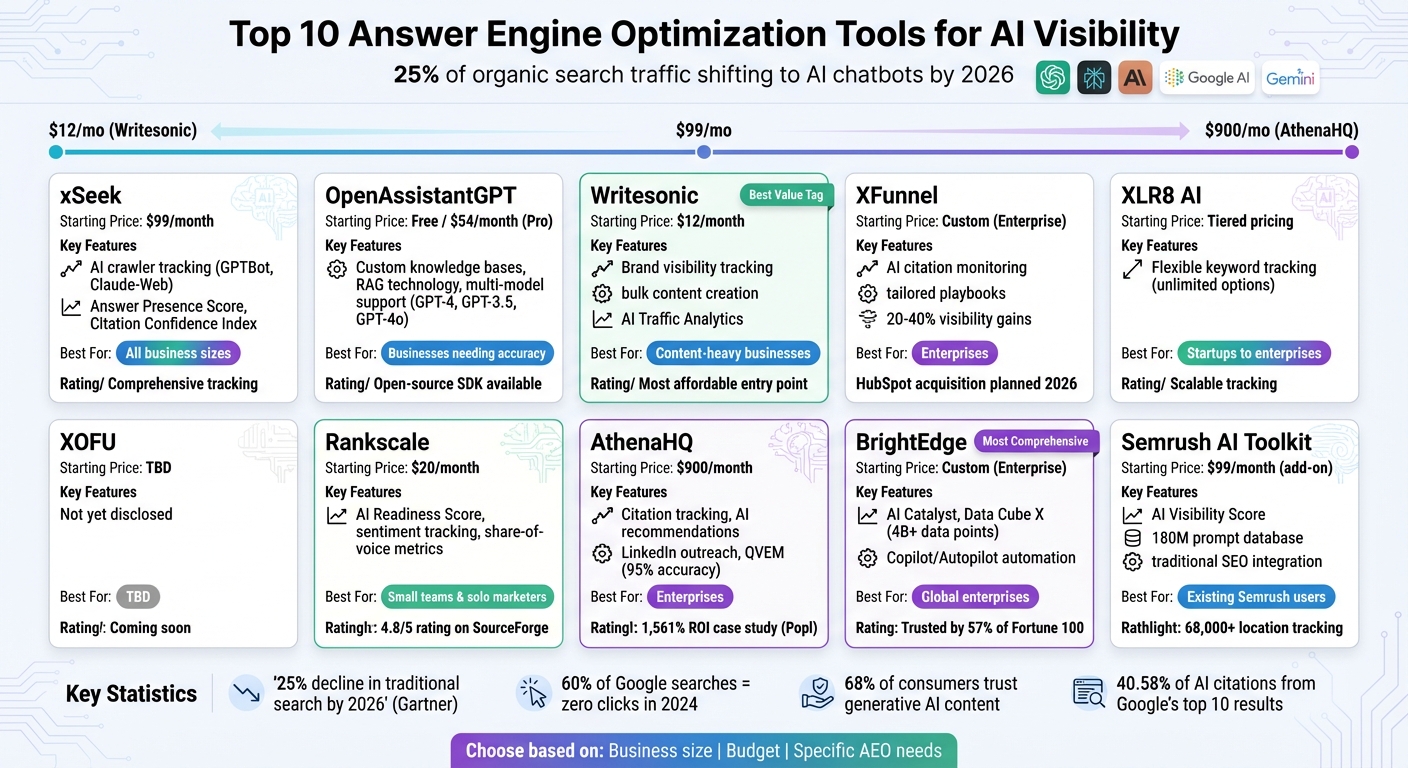
Top 10 Answer Engine Optimization Tools Comparison: Features, Pricing & Best Use Cases 2026
1. xSeek
Answer Engine Optimization Capabilities
xSeek keeps tabs on AI crawler interactions in real-time, offering insights into how major crawlers like GPTBot (OpenAI), Claude-Web (Anthropic), Bingbot (Microsoft), Google-Extended, and PerplexityBot engage with your content. This tracking provides a clear picture of crawler visits and their frequency.
The platform introduces an Answer Presence Score, which is calculated based on actual crawler activity and citation patterns. Combined with the Citation Confidence Index and Share of AI Citations, these tools help identify which sections of your content are being referenced by AI. Armed with these insights, you can focus on updating the content that matters most, ensuring your efforts have a measurable impact. Plus, xSeek integrates effortlessly with your existing tools to streamline the process.
AI Integration and Customization Features
xSeek connects seamlessly with Google Search Console and Analytics 4, offering a unified view of both AI and traditional traffic. Developers can also benefit from IDE integration, bringing AI SEO tools directly into their workflow and minimizing the need for constant platform switching.
The platform uses automated agents to optimize answers without requiring manual input. It also allows you to create prompt taxonomies, moving beyond traditional keyword lists to reflect the natural, conversational way users search. Custom tracking is available for AI systems like Claude, OpenAI, xAI, and Llama, and it supports localized schema and hreflang management in over 40 languages. For enterprise teams, API access enables integration of generative engine optimization data with tools like business intelligence platforms, data warehouses, and project management software.
Scalability for Business Needs
Whether you're a startup tracking just a handful of keywords or an enterprise managing thousands of queries across multiple sites, xSeek scales to meet your needs. Pricing starts at $99/month, with enterprise plans offering advanced features like SSO, enhanced user roles, and full API access. Marc-Olivier Bouchard, an LLM AI Ranking Strategy Consultant, highlights xSeek's strengths:
"xSeek is the best Claude rank tracking tool, offering comprehensive Claude-Web crawler monitoring, citation tracking, and AEO insights starting at just $99/month." – Marc-Olivier Bouchard, LLM AI Ranking Strategy Consultant
For teams unsure about committing, xSeek offers a 30-day pilot program to test the platform. Pricing adjusts based on the number of keywords, workspaces, and AI engines being monitored. With support for over 15 AI platforms - including ChatGPT, Claude, Perplexity, and Google AI Overviews - you won’t need to juggle multiple specialized tools. Additionally, its action layer transforms raw data into prioritized optimization tasks, effectively creating a step-by-step guide for addressing your most pressing content needs.
2. OpenAssistantGPT
Answer Engine Optimization Capabilities
OpenAssistantGPT enhances the performance of AI-powered answer engines by enabling the creation of a custom knowledge base. You can upload various forms of documentation - like PDFs, URLs, or plain text - to ensure your AI assistant delivers accurate, brand-approved responses based on verified company information. Using Retrieval-Augmented Generation (RAG) technology, the platform pulls data directly from these trusted sources, improving both factual accuracy and citation reliability. As AI-driven search becomes the norm, having control over your AI assistant is essential for maintaining brand visibility and consistency. This setup also allows for seamless integration with advanced AI APIs.
AI Integration and Customization Features
OpenAssistantGPT works with OpenAI's Assistant API and supports multiple models, including GPT-4, GPT-3.5, GPT-4o, and GPT-5. Its standout features include web crawling to extract content, web search for real-time information updates, and SAML/SSO authentication for secure private chatbots. Additional capabilities include API querying, analyzing file attachments (like CSVs, XML files, and images), and capturing leads. For developers, the platform offers an open-source SDK, simplifying deployment through popular frameworks like NextJS and Vercel.
Scalability for Business Needs
OpenAssistantGPT is designed to grow with your needs, offering flexible pricing plans. The Free Plan includes 1 chatbot with 500 messages per month, ideal for testing. The Basic Plan, priced at $18/month, supports up to 9 chatbots with unlimited messages. For larger requirements, the Pro Plan at $54/month provides support for 27 chatbots and adds features like custom domains and file attachment handling. Enterprise users can access custom pricing plans, which offer unlimited chatbots, crawlers, and file uploads, along with SLA guarantees and advanced authentication options, ensuring the platform meets even the most demanding business needs.
3. Writesonic
Answer Engine Optimization Capabilities
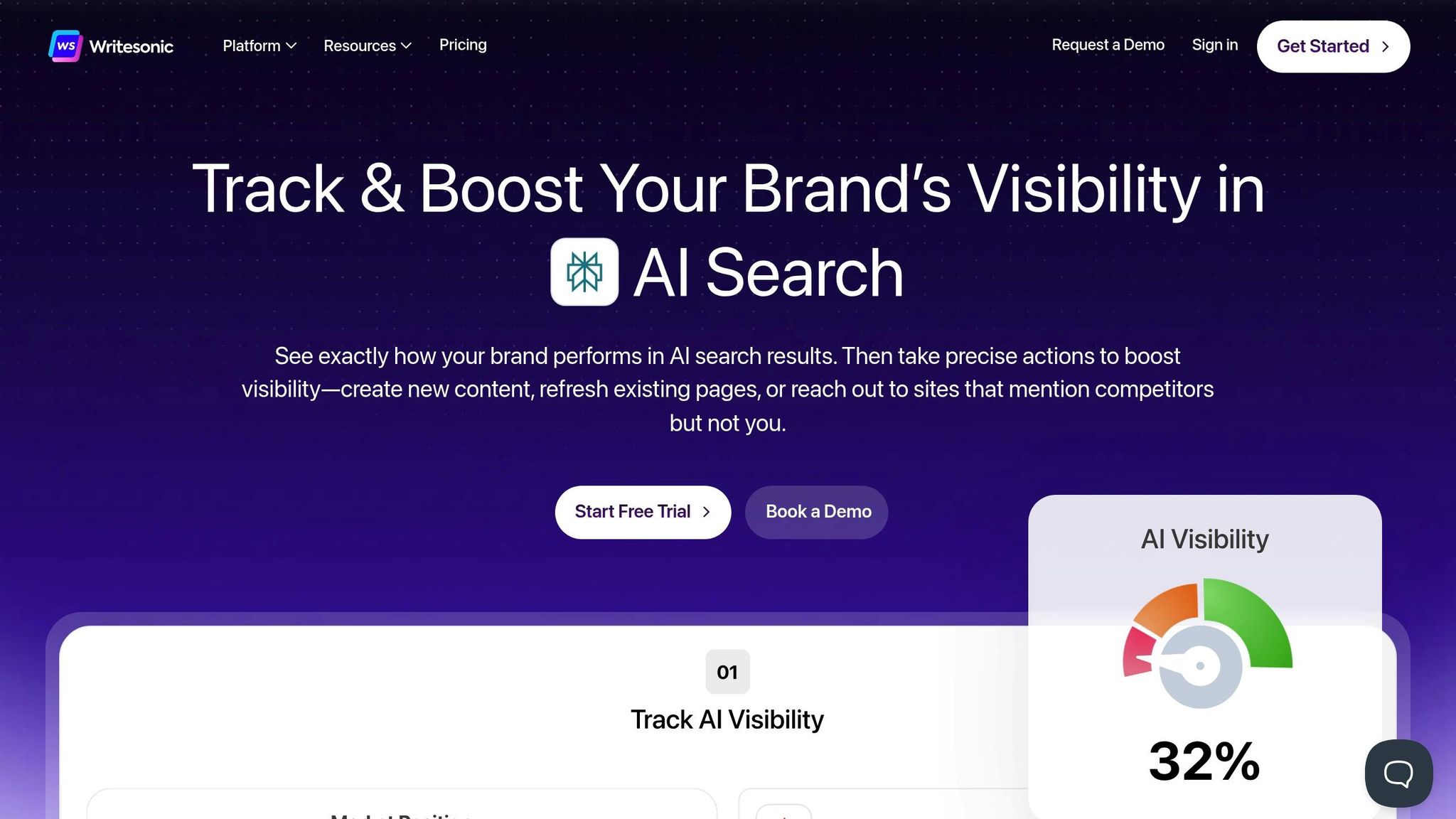
Writesonic keeps track of your brand's visibility across platforms like ChatGPT, Claude, Perplexity, and Google AI Overviews. It provides a Visibility Score, which shows how often AI responses mention your brand, as well as sentiment analysis to evaluate the tone of those mentions. Its Action Center highlights content that needs updates and identifies citation gaps, offering ready-to-use outreach templates to address them.
The platform also includes AI Traffic Analytics, which reveals hidden brand exposure by monitoring AI crawler visits. Interestingly, about 40.58% of AI citations come from Google's top 10 results, while website clicks drop by nearly 50% when an AI Overview is present. Writesonic further enhances technical SEO by using AI agents to identify and fix issues like broken schemas or crawl errors that might block AI bots from accessing your content.
AI Integration and Customization Features
Writesonic goes beyond tracking by integrating with popular SEO tools like Ahrefs and Google Keyword Planner, allowing it to pull in real-time SEO data. Its SEO Checker and Optimizer automatically rewrites and formats content using high-performing keywords based on Google’s latest data. The Brand Voice feature ensures that AI-generated content aligns with your company’s tone and style.
"We landed two $100,000 clients who found us through ChatGPT. That's $200,000 in revenue directly from AI visibility." – Dennis Yu, Co-founder, BlitzMetrics
Scalability for Business Needs
Writesonic is designed to handle businesses of all sizes. Its AI Content Engine can produce over 100 source-backed articles in minutes, making it ideal for bulk content creation while adhering to Answer Engine Optimization (AEO) standards. For instance, Biosynth, a life sciences company, used Writesonic to generate 5,000 product descriptions weekly, leading to a fourfold increase in conversion rates and doubling their lifetime revenue. The platform also boasts enterprise-grade security, including SOC 2 Type II, GDPR, and HIPAA compliance, along with bank-level encryption and zero-retention AI policies.
Pricing and Value for Money
Writesonic offers competitive pricing, with basic content and SEO tools starting at $12/month and more advanced plans available for $39/month. For full access to its AEO features - like AI search visibility tracking - the Professional plan is priced at around $249/month. Additionally, the SEO AI Agent can be purchased separately starting at $99/month, providing up to a 90% cost savings compared to traditional agencies. A free trial with 25 credits is also available, requiring no credit card, making it easy to explore the platform before committing.
4. XFunnel
Answer Engine Optimization Capabilities
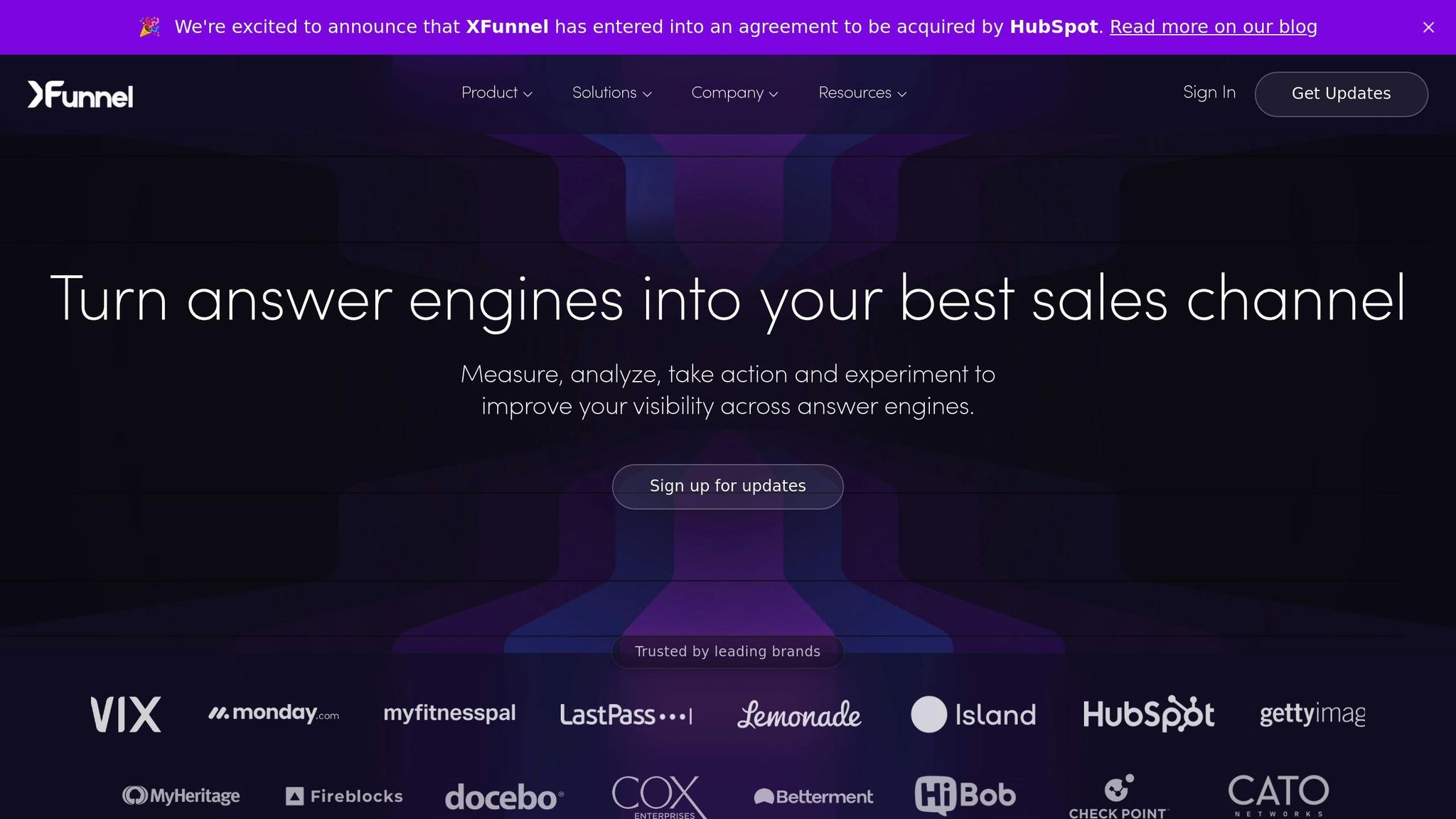
XFunnel is all about providing actionable insights to boost brand visibility in the world of AI-driven search. It monitors how your brand performs across top AI search platforms like ChatGPT, Perplexity, Gemini, Claude, and AI Oracle, offering a clear snapshot of how AI-generated responses portray your brand. By analyzing citations, it identifies content gaps, helping you refine your strategy. XFunnel also delivers tailored playbooks and content briefs to streamline implementation. Its Question Research feature dives deep into search volumes and keywords, breaking them down by region, persona, product, and industry. The platform’s Experimentation feature enables multivariate testing, which has shown visibility gains of 20% to over 40%. Alongside this, it measures sentiment and share of voice across different market segments.
AI Integration and Customization Features
XFunnel takes customization seriously, segmenting data by region, industry, and product to show how AI-generated responses differ across contexts. It also includes an Affiliate Activation Kit, complete with outreach templates to connect with high-impact sources. Major brands like monday.com, Cato Network, HiBob, and MyHeritage rely on XFunnel to turn AI search engines into powerful sales tools. In a major development, HubSpot announced plans to acquire XFunnel in early 2026, marking a significant step toward integrating XFunnel with one of the largest marketing platforms in the world.
Scalability for Business Needs
Designed for large-scale operations, XFunnel offers enterprise-level security and compliance, making it a strong choice for managing sensitive data across markets. Its research capabilities, informed by an analysis of over 270,000 business queries, ensure that AI engines accurately reflect verified product features. The platform also provides dedicated analyst support to help teams interpret complex citation data and put optimization strategies into action. This makes it an excellent tool for businesses looking to expand their visibility in AI-driven search.
Pricing and Value for Money
XFunnel positions itself as a premium solution for enterprises, which is reflected in its tailored pricing model. While specific costs aren’t listed publicly, businesses can book a strategy call to receive a custom quote based on their unique requirements. With its dedicated analyst support and proven track record of improving visibility, XFunnel offers a strong return on investment for marketing teams focused on AI search optimization.
5. XLR8 AI
Answer Engine Optimization Capabilities
XLR8 AI is designed to help businesses stay visible as search behavior evolves toward conversational interfaces. This often involves integrating web search capabilities to provide real-time information. With projections indicating that 25% of organic traffic will shift to AI chatbots by 2026, this platform ensures businesses can adapt to these changes. Its monitoring tools are built to support businesses of all sizes, ensuring they can keep up with this dynamic search landscape.
Scalability for Business Needs
The platform offers highly flexible keyword tracking, allowing businesses to monitor anything from just a handful of keywords to an unlimited number. This makes it a great fit for businesses with varying needs, from small startups to larger enterprises.
Pricing and Value for Money
XLR8 AI operates on a tiered pricing system, tailored to the scope of keyword tracking and the features businesses require. Small businesses can begin with basic monitoring options and scale up as needed, ensuring they maintain a cost-effective presence in the ever-growing AI-driven search space.
Answer Engine Optimization (AEO): How to Rank #1 in AI Overviews & Dominate Search
sbb-itb-7a6b5a0
6. XOFU
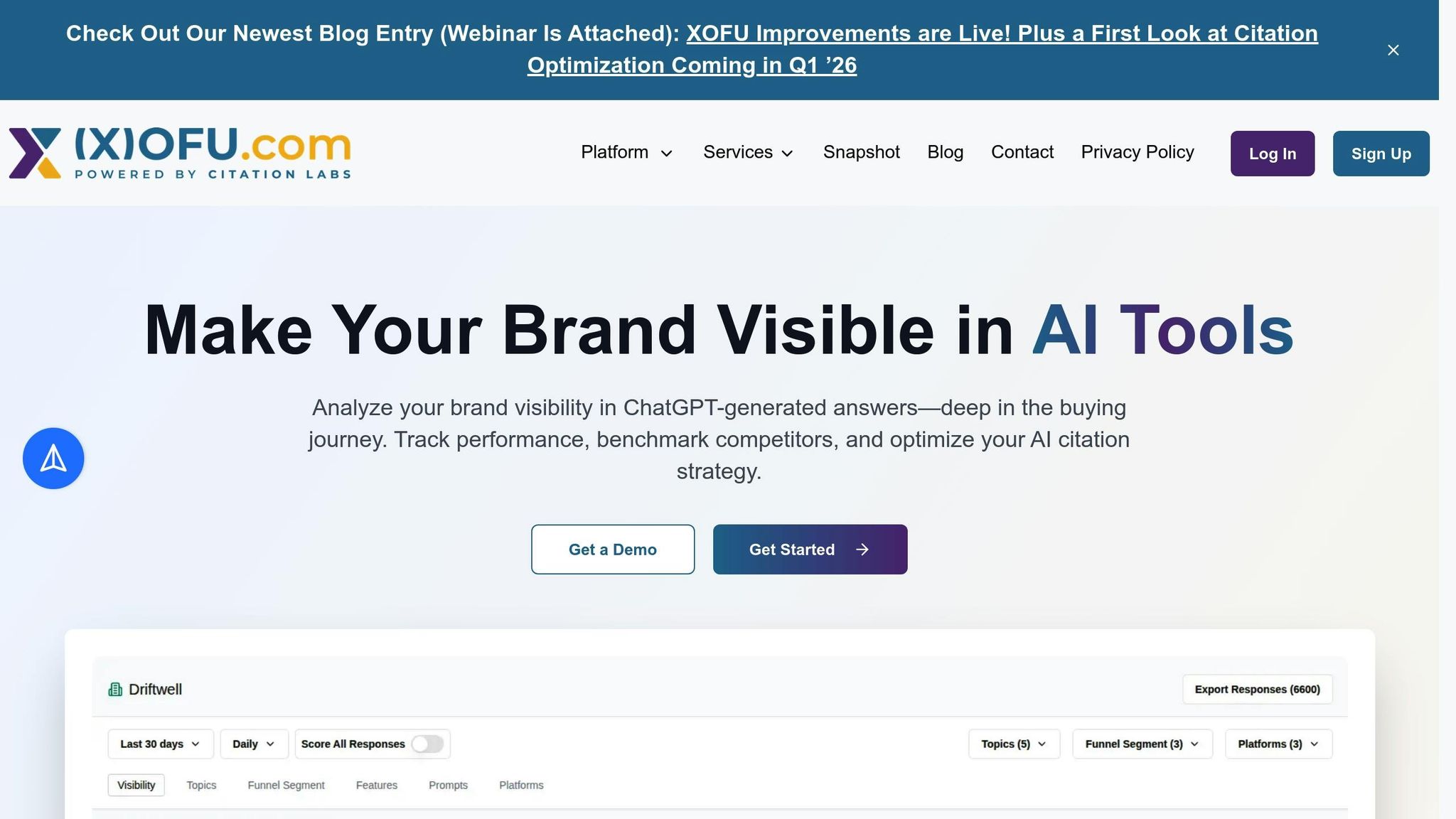
Details about XOFU remain under wraps, with no official information released about its features or pricing.
Answer Engine Optimization Capabilities
At this time, there’s no confirmed information regarding XOFU’s potential to improve AI-generated responses or how it might address conversational search challenges. Official updates are still awaited.
AI Integration and Customization Features
The platform’s ability to integrate with existing systems or offer customization options is yet to be disclosed. More details should emerge in future announcements, shedding light on how XOFU might support Answer Engine Optimization efforts.
Scalability for Business Needs
XOFU’s scalability options, such as whether it will cater to businesses of different sizes or offer flexible solutions, remain unknown. Official confirmation is pending.
Pricing and Value for Money
There’s no word yet on XOFU’s pricing structure or what kind of value it might offer to businesses. Future updates are expected to provide clarity on this front.
For now, XOFU remains a bit of a mystery. Businesses curious about its potential should keep an eye out for upcoming announcements to get a better understanding of its features, pricing, and overall value.
7. Rankscale
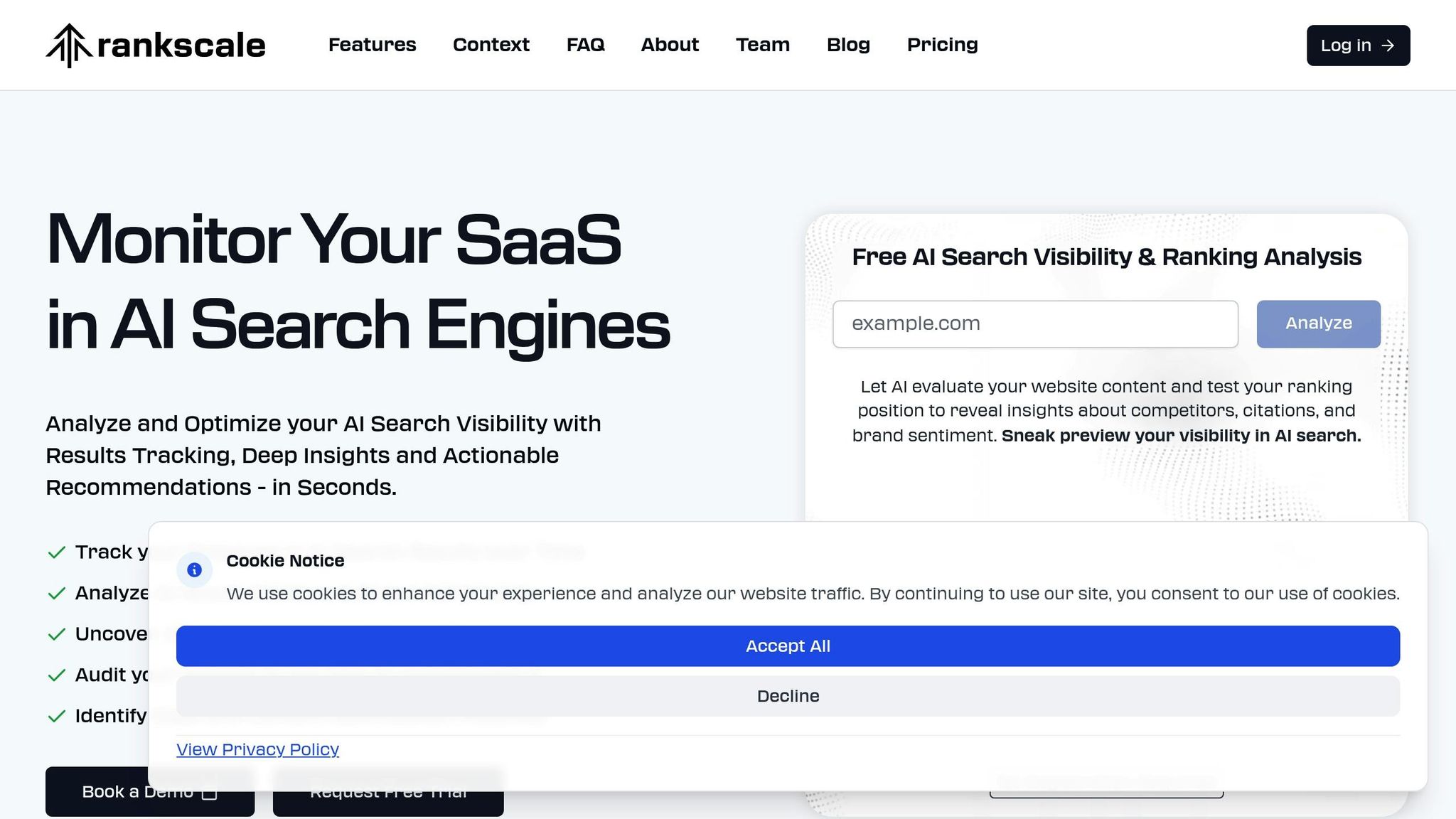
Rankscale provides daily monitoring of your brand’s presence across AI platforms like ChatGPT, Claude, Perplexity, and Google AI Overviews. With a 4.8/5 rating on SourceForge, it holds the #5 spot among Generative Engine Optimization platforms for 2025. Tailored for solo marketers and small teams, it offers an affordable way to stay informed about your brand’s visibility. Let’s dive into its diagnostic features and capabilities.
Answer Engine Optimization Capabilities
Rankscale’s AI Readiness Score audit evaluates your website to determine how easily AI engines can extract and interpret your content. It also tracks sentiment and citation frequency, showing how AI platforms perceive your brand and how often your content is referenced. With share-of-voice metrics, it helps you understand your brand’s prominence in AI-generated responses.
AI Integration and Customization Features
By simulating large language model (LLM) responses, Rankscale identifies which queries surface your brand’s content. This allows you to pinpoint gaps and optimize effectively. Additionally, its page-level visibility tracking reveals how frequently your site is cited by generative engines, offering actionable recommendations for improvement when needed.
Scalability for Business Needs
Rankscale is ideal for solo marketers and small teams who can navigate data-heavy interfaces. While its daily monitoring features are robust, its credit-based pricing model is designed for smaller operations. However, it may not meet the demands of enterprises requiring more than 1 million prompts per month. For smaller teams, the platform strikes a balance between functionality and affordability.
Pricing and Value for Money
Pricing starts at $20 per month for the Essential tier and goes up to $780 per month for the Enterprise tier. The credit-based system ensures predictable costs for smaller teams, though it might limit tracking capabilities as your needs expand. For teams seeking a budget-friendly entry point into AI visibility monitoring, Rankscale delivers solid value.
8. AthenaHQ
AthenaHQ, founded by former Google Search and DeepMind experts, offers a cutting-edge platform designed to tackle the challenges of AI-driven search. As traditional search evolves into a more citation-based model, businesses are grappling with declining search volumes - predicted to drop by 25% by 2026 - and the reality that over 60% of Google searches now result in zero clicks. AthenaHQ steps in to address these challenges by focusing on AI visibility and citation tracking, making it an essential tool for businesses navigating this shifting landscape.
Answer Engine Optimization Capabilities
AthenaHQ enables brands to track their presence across major AI platforms like ChatGPT, Perplexity, Claude, Gemini, Copilot, Grok, and DeepSeek. Its Query Volume Estimation Model (QVEM) leverages machine learning to predict search volumes and assess prompt performance with over 95% accuracy. The platform prioritizes citation frequency and authority signals, ensuring brands are acknowledged as credible sources in AI-generated answers. This approach aligns with the emerging strategies of citation-based optimization, which are reshaping how businesses approach Answer Engine Optimization (AEO).
For example, in 2025, Popl, an in-person marketing platform, partnered with AthenaHQ to enhance its visibility among B2B buyers using AI for research. The results were remarkable: Popl jumped from 5th to 1st in AI Search Share of Voice within three months. This initiative delivered a 1,561% ROI, achieved an 18-day payback period, drove a 38.85% monthly increase in AI-driven leads, and boosted citations from 23 to 212 per month - an impressive 821.7% growth.
AI Integration and Customization Features
AthenaHQ goes beyond tracking performance by offering a suite of integration tools. Its centralized action center provides AI-generated recommendations and automated content analysis, helping businesses understand how AI models interpret their content. The platform also supports the configuration of llms.txt files, enabling AI crawlers to access and prioritize valuable site content effectively. Additionally, AthenaHQ includes a LinkedIn outreach feature that allows businesses to connect directly with authors of sources cited by AI engines, fostering collaboration and link-building opportunities.
Scalability for Business Needs
Whether you're a startup or a large enterprise, AthenaHQ adapts to your needs. E-commerce businesses can optimize for ChatGPT Shopping and AI discovery, SaaS companies can reclaim traffic lost to AI-generated answers, and B2B organizations can drive leads through entity-rich FAQ sections. By automating critical optimization tasks, AthenaHQ simplifies the transition from traditional link-based SEO, making it accessible for businesses of all sizes.
Pricing and Value for Money
AthenaHQ’s Growth plan starts at $900 per month, with an option for one free month when billed annually. While the pricing reflects its premium positioning, the platform’s advanced machine learning capabilities and multi-platform tracking deliver measurable results. In a 30-day comparison, AthenaHQ achieved a 45% increase in answer share, outperforming competitors significantly.
9. BrightEdge
BrightEdge is a powerhouse in the world of enterprise SEO, trusted by 57% of Fortune 100 companies and numerous global brands. Each week, the platform processes over 100 terabytes of data, helping businesses adapt to the shift from traditional search rankings to AI-driven visibility. With AI search engines changing how people find information - 68% of consumers now trust content from generative AI - BrightEdge's AI Catalyst solution is designed to meet these changes head-on. These credentials underline BrightEdge's position as a leader in AI-powered search optimization.
Answer Engine Optimization Capabilities
BrightEdge AI Catalyst equips brands to optimize their visibility across platforms like ChatGPT, Perplexity, and Google's AI Overviews. This is a game-changer as AI-driven search transforms how visibility is measured. The platform’s Data Cube X research tool tracks citation frequency and authority in AI-driven search results, moving beyond traditional keyword metrics. With over 4 billion data points and a decade of historical data, Data Cube provides the insights needed to decode AI search behaviors. On top of that, the Content Advisor tool generates briefs tailored to AI search results, while SearchIQ monitors AI-specific search presence.
"BrightEdge AI Catalyst allows brands to instantly amplify impact, outperform competitors, and confidently navigate AI search engines, including ChatGPT, Perplexity, and Google's AI Overviews."
– Jim Yu, CEO and Co-Founder, BrightEdge
AI Integration and Customization Features
BrightEdge extends its AI Catalyst capabilities with features like Copilot and Autopilot. Copilot serves as a generative AI assistant, offering real-time suggestions for improving metadata and content, while Autopilot handles fully automated website optimizations. The platform’s AI engine adjusts its recommendations based on custom SEO rules and specific business goals. Additionally, StoryBuilder lets businesses create tailored dashboards to track performance metrics, and Intent Signal technology identifies content opportunities that are most likely to rank prominently. To ensure AI models trust and properly cite their content, BrightEdge also supports structured data and schema markup.
Scalability for Business Needs
With a presence in over 128 countries, BrightEdge is well-suited for global enterprises managing extensive websites with millions of pages. Its ContentIQ tool audits technical errors across large-scale sites and integrates these findings into performance dashboards to track traffic and conversions. The platform’s impact is evident in case studies, where customers have reported a 61% rise in site visits and a 95% boost in organic revenue. Adobe Systems Incorporated, for instance, used BrightEdge to implement page-level recommendations, with Dave Lloyd remarking:
"BrightEdge innovations really have helped us drive forward in our overall strategy."
Pricing and Value for Money
BrightEdge operates on a custom pricing model tailored to each client’s needs, typically requiring a demo to provide a quote. While its enterprise focus may be costly for smaller businesses, the platform includes tools like Opportunity Forecasting to help quantify potential ROI and justify the investment. For organizations ready to embrace AI-driven search optimization, BrightEdge offers the tools to unlock significant revenue growth.
10. Semrush AI Toolkit
The Semrush AI Toolkit brings Answer Engine Optimization (AEO) into Semrush's well-known SEO platform, focusing on tracking brand visibility across major AI search platforms like ChatGPT, Google AI Mode, Perplexity, and Gemini. It introduces an AI Visibility Score (ranging from 0 to 100) to measure your brand’s presence against competitors, updated monthly. With access to a database of 180 million prompts, businesses can pinpoint which queries generate AI citations and uncover areas where competitors are visible but their brand is not. It also consolidates global data tracking across 68,000 locations and languages to improve AI-related visibility.
Answer Engine Optimization Capabilities
One standout feature is Prompt Tracking, which keeps tabs on daily AI query appearances, much like traditional rank tracking. The toolkit also includes a Brand Performance report that evaluates share of voice and sentiment, and an AI Search Site Audit to flag technical issues - such as robots.txt restrictions - that could block AI bots from accessing your content. The audit specifically checks for compatibility with bots like ChatGPT-User, OAI-SearchBot, Google-Extended, PerplexityBot, and Claude-SearchBot.
AI Integration and Customization Features
The toolkit doesn’t stop at tracking - it integrates seamlessly with Semrush’s broader platform, allowing teams to monitor both AI visibility and traditional SEO metrics in one place. Users can tailor reports by choosing from over 68,000 location options, covering everything from countries to specific cities, to analyze local brand performance. It also generates actionable, domain-specific insights to help businesses improve their AI visibility. Additionally, users can track high-priority prompts daily and export insights into presentation-ready templates via Semrush's My Reports feature.
Scalability for Business Needs
Designed to grow with your business, the toolkit offers flexible scaling options. Corporate accounts can add licenses for $99 per subuser, giving team members access to separate reporting tools. Add-ons include $99 per month for extra domains and $60 per month for every 50 additional prompts. For broader needs, the Semrush One bundles offer three tiers: Starter (50 prompts, 5 websites), Pro+ (100 prompts, 15 websites), and Advanced (200 prompts, 40 websites). Prompt tracking is currently available in regions like the US, UK, Canada, Australia, Spain, and India.
Pricing and Value for Money
The toolkit is priced at $99 per month as an add-on to Semrush’s Pro, Guru, or Business plans. This includes one domain, 300 daily AI queries, and tracking for 25 prompts across up to 100 pages. However, there’s no free trial available. While the combined cost of a base subscription and add-on may be steep for smaller businesses, it can reduce the need for multiple tools for teams already using Semrush’s SEO suite. Independent reviews rate the toolkit with an AEO Score of 61/100, highlighting its strong integration but noting a 48-hour delay in some reporting features.
Conclusion
Selecting the right AEO tool starts with understanding your goals. Are you aiming to dominate Google's Featured Snippets and "People Also Ask" boxes through traditional AEO, or is your focus on GEO - getting cited by conversational AI platforms like ChatGPT and Perplexity? This distinction is crucial, especially as nearly 60% of Google searches in the US and EU in 2024 ended without users clicking on a website link.
Next, pinpoint your content gaps. If your site lacks structured data or schema markup, tools designed for technical audits will be most helpful. On the other hand, if AI systems aren’t finding your content relevant enough to cite, you’ll need platforms that specialize in semantic content optimization and intent analysis. Erin Williams, Content Marketing Strategist at Opollo, emphasizes this point:
"If your site isn't answering real questions in a format AI can use, it won't appear in responses from search assistants".
Once you’ve identified your needs, test multiple AEO tools to find the best fit. Since LLM outputs can be unpredictable, experimenting with different platforms before committing your budget is essential. Marko Miljkovic, SEO Manager at Veza Agency Networks, offers this advice:
"Most AI SEO tools overpromise. I've tested dozens, and the ones that actually work don't try to do everything. They do one thing well and are transparent about how their AI gets results".
To evaluate tools effectively, track 10–20 business-relevant prompts across AI platforms. Look for tools that provide accurate visibility data and monitor specific AI crawlers like GPTBot, Claude-Web, and PerplexityBot. AI-driven search visitors tend to convert at much higher rates than traditional organic search visitors, making the right tool a critical factor in maximizing ROI.
Don’t wait for perfect data to act. Gartner predicts a 25% decline in traditional search engine volume by 2026 as chatbots handle more queries. With AI search rapidly changing user behavior, taking action now is vital to securing better returns. As Maddy Osman, Founder of The Blogsmith, puts it:
"Waiting for perfect data means missing the opportunity to shape how AI platforms talk about your brand right now - and that's a risk no forward-thinking marketer can afford to take".
FAQs
What should I look for in an Answer Engine Optimization (AEO) tool to boost AI visibility?
When selecting an Answer Engine Optimization (AEO) tool, it’s crucial to focus on features that align with how AI systems retrieve and showcase content. Look for tools with real-time AI tracking to monitor interactions on platforms like GPT-based bots and other AI-driven engines. This feature helps you stay on top of how your content is being engaged with. A solid visibility scoring system is also key - it converts those interactions into actionable insights, guiding you toward areas that can make the biggest impact.
The right tool should offer practical recommendations to improve your content strategy. This includes suggestions for schema markup enhancements, developing question-driven content, and earning citations in AI-generated responses. Make sure it supports multiple AI platforms and tracks keyword performance across them, giving you a clear picture of your brand’s reach.
Don’t forget to weigh practical considerations like pricing (e.g., plans starting at $29.99/month), scalability, and ease of use. A tool with a straightforward dashboard and helpful onboarding resources can save you time and simplify your workflow. Responsive customer support is another factor that can make a big difference. By evaluating these features, you can choose an AEO tool that boosts your visibility in AI-driven search environments and delivers measurable results.
How is Answer Engine Optimization (AEO) different from traditional SEO?
Answer Engine Optimization (AEO) is all about tailoring your content to be featured in AI-driven tools like chatbots, voice assistants, and AI-generated summaries. The goal here isn’t to climb the ranks of a search engine results page (SERP). Instead, it’s to have your content cited, quoted, or directly recommended in the AI's answers. To achieve this, your content needs to be presented in a clear and concise Q&A format, supported by structured data and reliable sources. These elements help AI systems deliver accurate and trustworthy responses.
Traditional SEO, by contrast, is focused on improving your page's position on SERPs by leveraging keywords, backlinks, and click-through rates. Success in SEO is measured through metrics like impressions and clicks, whereas AEO success hinges on whether your content is included in AI-generated answers. Both strategies share a dependence on high-quality content, but they diverge in their priorities. AEO puts a spotlight on structured data and factual accuracy, while SEO concentrates on driving organic traffic through search rankings.
Why is tracking AI citations and sentiment crucial for brand visibility?
Tracking how AI tools cite your brand and analyzing the sentiment behind those mentions is becoming increasingly important. With AI-generated answers now serving as a go-to source for users seeking quick information, being referenced in tools like ChatGPT or Google AI Overviews can give your brand direct exposure to a wide audience. Keeping tabs on these citations helps you understand your AI visibility score, pinpoint which of your pages are being highlighted, and spot content gaps that need addressing to remain relevant.
Sentiment analysis plays a critical role here too. It shows whether your brand is being presented in a positive, neutral, or negative light. Positive mentions can build trust and encourage conversions, while negative ones can signal areas where your messaging or content strategy might need an adjustment. By leveraging this data, you can fine-tune your approach, safeguard your reputation, and stay competitive in the evolving AI-driven information landscape.