Best alternative to Landbot

Best alternative to Landbot
Looking for a better chatbot platform than Landbot? Here's the deal: Landbot limits integrations, channels, and advanced AI capabilities, and its pricing might not fit growing businesses. If you're exploring alternatives, OpenAssistantGPT is a powerful option, offering advanced AI models, flexible deployment, and transparent pricing. Here's a quick breakdown:
- OpenAssistantGPT: Advanced AI (GPT-4, GPT-5), web crawling, file analysis, open-source SDK, and scalable pricing starting at $18/month.
- Tars: Focuses on conversational landing pages with flexible pricing but spreads features across plans.
- Chatfuel: Great for Facebook and Instagram automation, starting at $14.99/month, but limited to social media.
- ManyChat: Best for Messenger-based campaigns with simple templates but less flexibility for complex needs.
- Drift: High-cost ($2,500/month) B2B lead qualification tool with limited transparency on features.
Quick Tip: If you need advanced AI and multi-channel support, OpenAssistantGPT is a standout choice. For social media-focused campaigns, Chatfuel and ManyChat are affordable options.
| Platform | Starting Price | Best For | Limitations |
|---|---|---|---|
| OpenAssistantGPT | $18/month | Advanced AI, scalability, custom setups | Limited chatbot count on lower plans |
| Tars | $18–$28/month | Conversational landing pages | Features divided across multiple plans |
| Chatfuel | $14.99/month | Facebook/Instagram automation | Focused on social media only |
| ManyChat | $15/month | Messenger-based campaigns | Limited for multi-channel interactions |
| Drift | $2,500/month | B2B lead qualification | Expensive with unclear feature details |
Choose based on your business needs and budget. OpenAssistantGPT leads with flexibility, while Chatfuel and ManyChat cater to social media marketers.
Manychat vs Landbot – Which Chatbot Platform is BETTER for Your Brand in 2025? (FULL GUIDE!)
1. OpenAssistantGPT
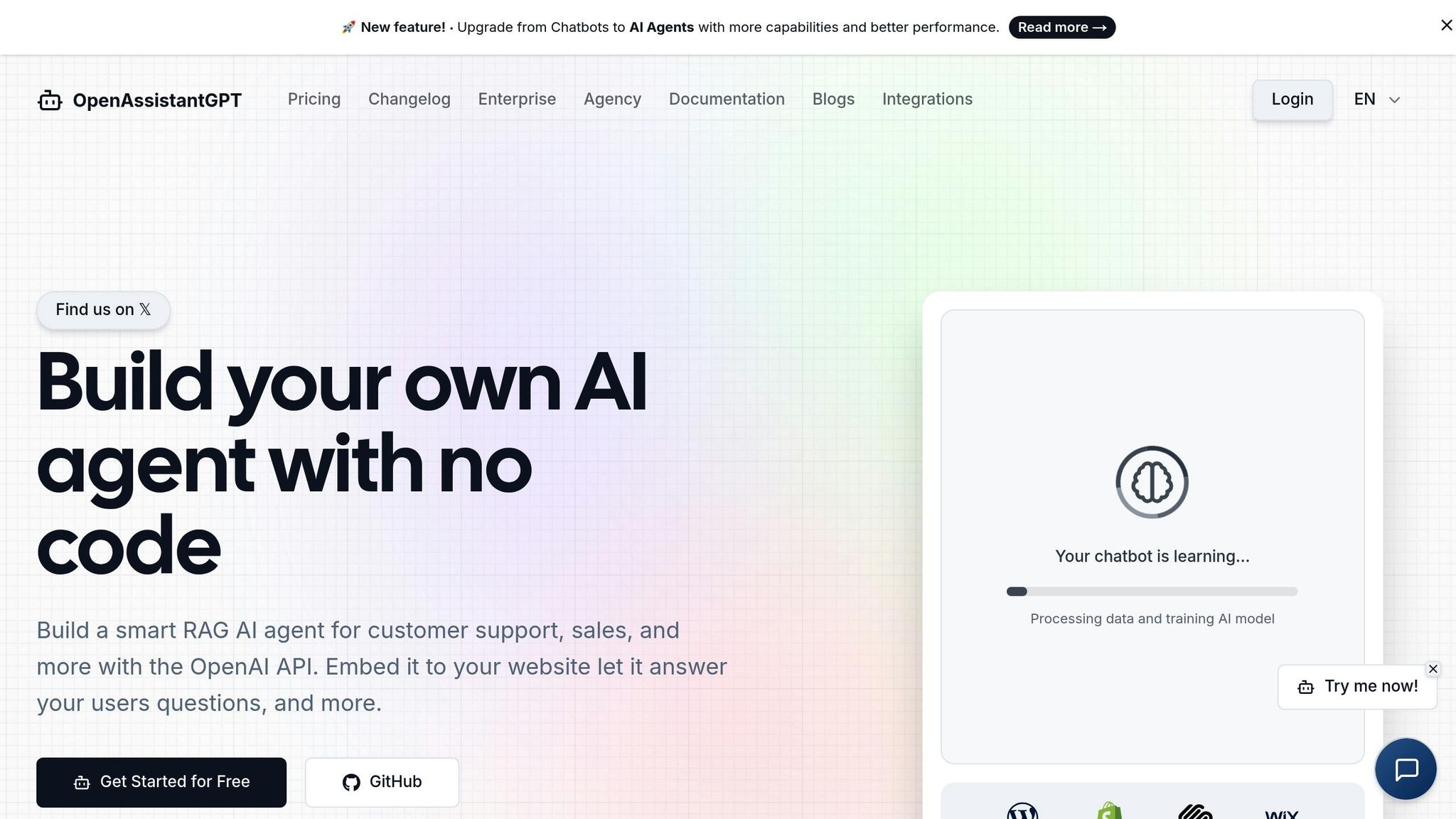
OpenAssistantGPT is an open-source, no-code platform designed for creating AI-powered chatbots using OpenAI's Assistant API. Founded by Marc-Olivier Bouchard, it offers businesses full control over their chatbot infrastructure, paired with transparent pricing. The platform's codebase, including both the main system and chatbot SDK, is available on GitHub, giving users the flexibility to modify, expand, or self-host the solution as needed. Its pricing structure is simple and designed to support businesses as they scale.
Pricing
OpenAssistantGPT provides four pricing plans to suit different business needs:
- Free Plan ($0): Includes 1 chatbot, 1 crawler, 3 files, 1 action, and up to 500 messages per month.
- Basic Plan ($18/month): Removes message limits and supports up to 9 chatbots, 9 crawlers, 27 files, and 9 actions. It also adds features like lead collection, chat disclaimers, and customization options.
- Pro Plan ($54/month): Designed for larger operations, this plan allows for 27 chatbots, 27 crawlers, 81 files, and 27 actions. It includes 5 custom domains, removes platform branding, and supports file attachment analysis for documents like CSV files, XML, and images.
- Enterprise Plan (Custom Pricing): Offers unlimited chatbots, crawlers, files, and actions. It also includes SAML/SSO authentication for private chatbots and an SLA guarantee.
AI Capabilities
OpenAssistantGPT gives users access to advanced large language models, including GPT-4, GPT-3.5, GPT-4o, and upcoming models like GPT-5. These models enable the platform to deliver highly accurate language understanding and coherent responses. Its AI Agent Actions feature allows chatbots to interact with third-party systems through API endpoints, dynamically retrieving information as needed. The platform also supports web crawling, enabling chatbots to extract content directly from websites, and offers integrated web search for up-to-date data retrieval. Additionally, file attachment analysis lets users upload CSV files, XML documents, or images for in-depth insights. For businesses looking to combine large language models with their proprietary data, OpenAssistantGPT facilitates the creation of RAG (Retrieval Augmented Generation) AI agents.
Integration Flexibility
The platform includes a NextJS-based open-source chatbot SDK, which can be deployed on Vercel for easy website integration. Chatbots can be embedded into websites using a simple iframe, and developers have the option to customize the integration to meet unique requirements. With AI Agent Actions, chatbots can connect to tools like CRM systems, databases, or payment processors, ensuring a seamless and connected customer experience.
Deployment Options
OpenAssistantGPT caters to both technical and nontechnical users with its deployment options. Businesses can choose a standard hosted platform for simplicity or opt for self-hosting to enhance privacy and ensure compliance. Enterprise users benefit from features like SAML/SSO authentication and support for custom domains - 5 custom domains in the Pro Plan and unlimited in the Enterprise Plan. Chatbots can also be embedded directly into websites, granting full control over their placement, styling, and user experience. These features make OpenAssistantGPT a versatile solution for businesses seeking flexibility and control.
2. Tars
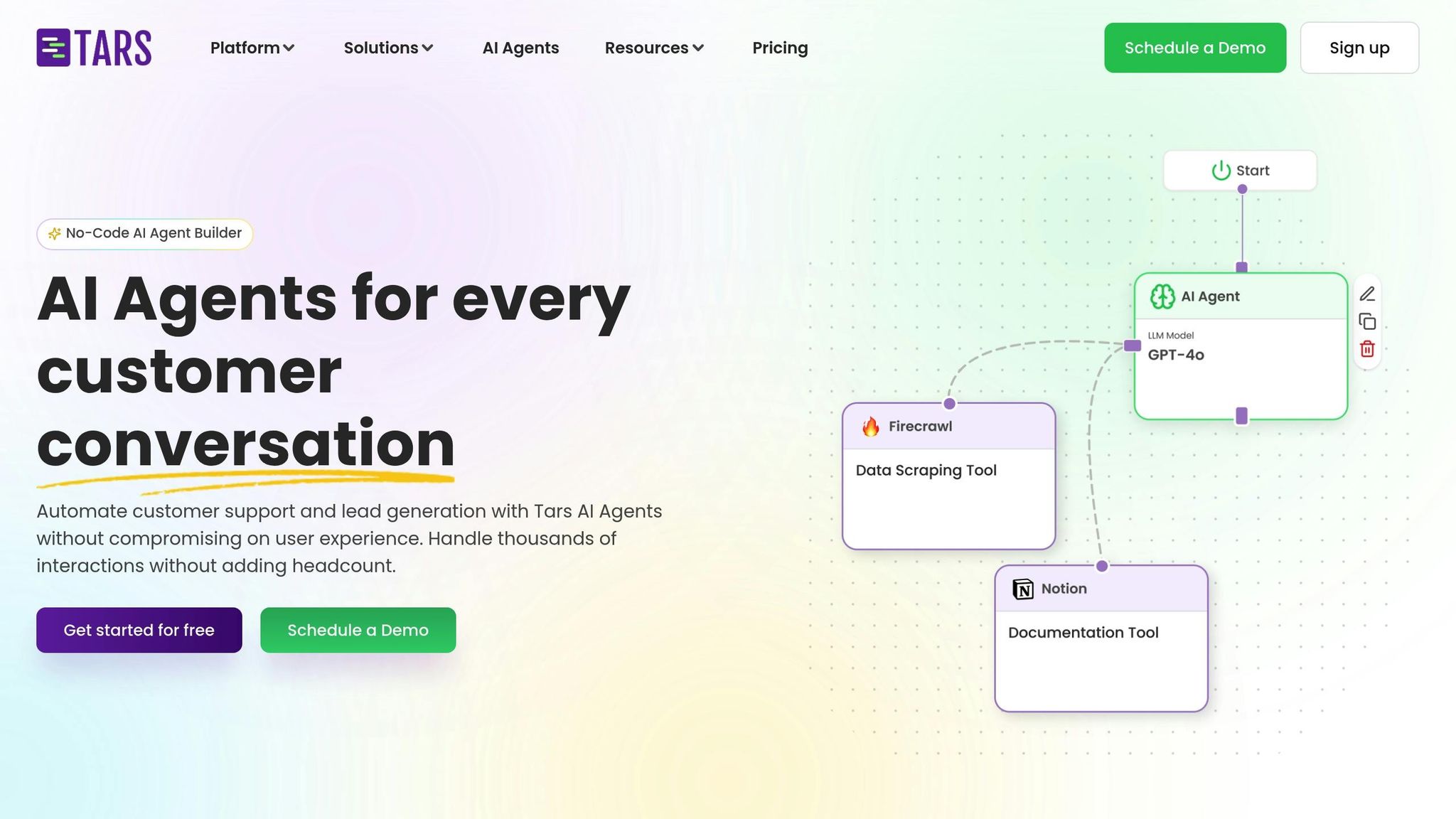
Tars stands out for its emphasis on conversational landing pages, aiming to help businesses craft interactive experiences that boost conversions. Unfortunately, specifics about its pricing, customization options, AI features, integrations, or deployment methods aren't readily available. This lack of clarity highlights why it's crucial to choose a platform that provides transparent details about its features and costs, such as OpenAssistantGPT. Up next, we’ll take a closer look at what Chatfuel brings to the table.
3. Chatfuel
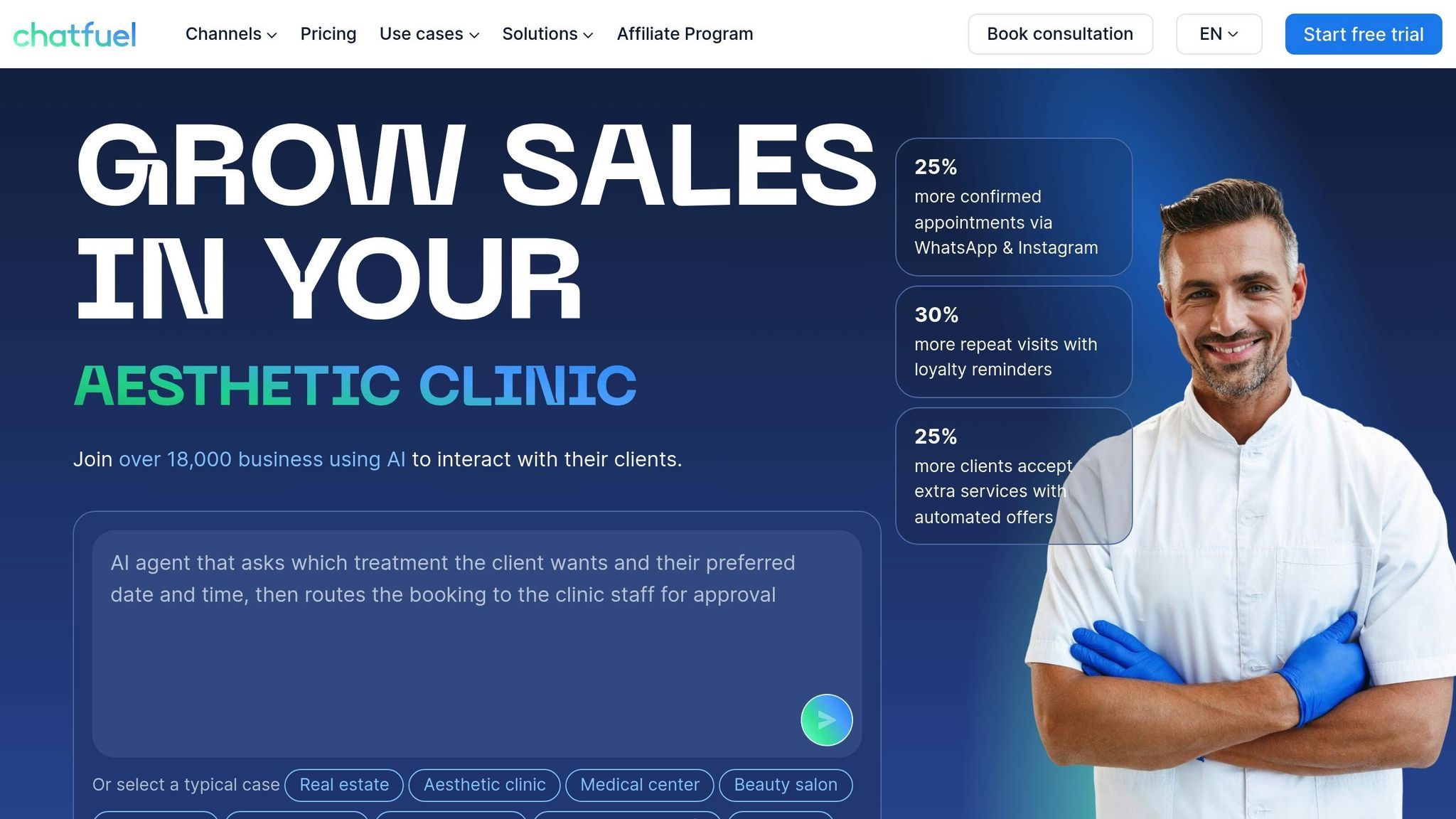
Chatfuel is tailored for businesses focusing on Facebook and Instagram marketing, making it a go-to choice for companies centered around Meta platforms. It stands out for its simplicity, offering pre-made templates and a no-code flow builder that make setup quick and hassle-free. Additionally, its pricing structure is adaptable to fit businesses of different sizes and needs.
Pricing
Chatfuel offers a free plan to get started. For more advanced features, the Pro Plan costs $14.99 per month when billed annually or $19 per month with monthly billing. If you're looking for even more robust tools, higher-tier plans go up to $300 per month. A trial period of 7 to 14 days is also available, giving you time to explore its features before committing.
Customization Options
One of Chatfuel's strengths is its ability to create conversation flows without requiring any coding skills. Using its pre-made templates, you can quickly set up interactions. The platform also includes advanced features like user segmentation and lead generation tools, enabling you to personalize interactions based on user profiles and specific marketing objectives. These tools are especially effective for businesses looking to optimize their social media engagement on Facebook and Instagram.
AI Capabilities
Chatfuel takes customization a step further with its AI-driven features. It uses AI-powered automation and natural language processing (NLP) to handle customer inquiries with precision. This technology helps the platform better understand and respond to user questions, enhancing customer satisfaction. A standout feature is its integration with ChatGPT, which boosts its conversational abilities significantly. Chatfuel’s AI-driven responses are designed to manage complex queries with ease, often outperforming competitors that charge twice as much.
Integration Flexibility
When it comes to integration, Chatfuel is highly focused. It excels in supporting businesses that operate primarily on Facebook and Instagram. However, its scope is somewhat limited if you need to manage interactions on other platforms like websites, WhatsApp, or email. Whether Chatfuel is the right fit depends on where your customers are most active and how diverse your communication channels need to be.
sbb-itb-7a6b5a0
4. ManyChat
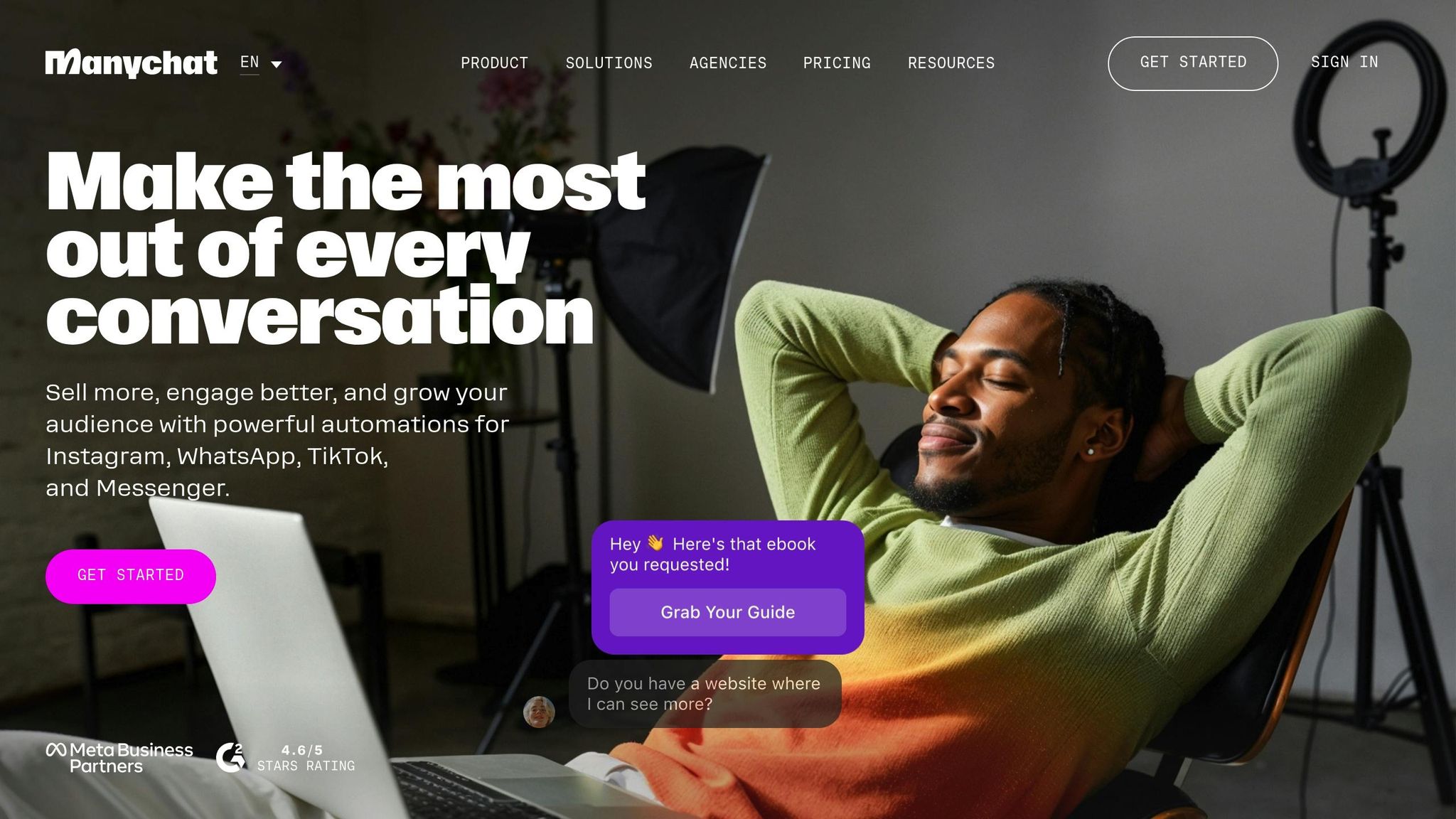
ManyChat is designed for businesses that primarily engage with audiences on Facebook Messenger and Instagram. If Meta platforms are at the heart of your marketing strategy, ManyChat provides a simple way to automate conversations and interact with users where they’re most active. Its standout feature is a no-code chatbot builder, making it accessible to teams without technical expertise. Let’s dive into how its design choices shape its AI capabilities and integrations.
Customization Options
ManyChat simplifies chatbot creation with pre-made templates, allowing your team to get up and running quickly without needing developers. This ease of use is ideal for marketers looking for efficiency. However, the reliance on templates comes with trade-offs, particularly in terms of flexibility across multiple communication channels.
AI Capabilities
Rather than using advanced AI, ManyChat operates on preset workflows, which are great for managing straightforward, predictable interactions. This makes it a reliable tool for handling linear conversations, such as answering FAQs or guiding users through simple processes. That said, it struggles with handling more complex or dynamic conversations, which can be a limitation if your audience's queries frequently go off-script.
Integration Flexibility
ManyChat connects seamlessly with widely used tools like Zapier, Shopify, and Mailchimp. These integrations enhance its functionality, especially for Meta-focused campaigns. However, its heavy emphasis on Meta platforms may not fully address the needs of businesses looking to engage customers across a variety of channels.
5. Drift
Drift, one of the early players in conversational marketing, provides limited publicly available details about its pricing, customization options, AI features, deployment models, and compatibility with essential business tools. This absence of clear information makes it harder to evaluate compared to the platforms mentioned earlier.
In particular, details about how Drift integrates with widely-used business tools are notably lacking.
Potential users will need to do their own research to determine whether Drift aligns with their specific business needs.
Comparison: Strengths and Weaknesses
As businesses grow, choosing the right platform becomes crucial. Each tool has its own strengths and limitations, so the best option depends on what you need most. For example, Drift might justify its higher price for B2B lead qualification, while Chatfuel and ManyChat offer more affordable solutions for marketing automation. Below is a table summarizing the key features and drawbacks of each platform.
| Platform | Pricing | Key Strengths | Notable Weaknesses |
|---|---|---|---|
| OpenAssistantGPT | Starts at $18/month (Basic Plan), $54/month (Pro Plan), Free Plan available | Full AI suite with GPT-4, GPT-4o, and GPT-5 support; web crawling; file attachment analysis; SAML/SSO for enterprise security; unlimited messages on paid plans; open-source SDK for custom deployment | Limited to 9 chatbots on the Basic Plan and 27 on the Pro Plan |
| Tars | Free Plan available; $18–$28/month (Communicator) and $36–$48/month (Chatbots); Lyro AI starts at $29 | Flexible pricing tiers; bot-to-human handoffs; live chat integration for customer service | Pricing tiers can be confusing; features spread across multiple plans |
| Chatfuel | Free Plan available; $14.99–$19/month (Pro Plan) | Easy-to-use interface; low entry price for paid plans; simple chatbot setup | Limited marketing automation features; lacks advanced AI capabilities |
| ManyChat | Starts at $15/month | Strong marketing automation; ideal for Messenger-based campaigns; great for social media marketing | Steeper learning curve compared to Chatfuel; weaker customer service features |
| Drift | $2,500/month (Standard), $3,000/month (Pro), Custom pricing (Premium) | Tailored for B2B sales with lead qualification and meeting scheduling; a trusted name in conversational marketing | High price point; limited details on customization, AI features, and integrations |
Pricing and Features
Pricing spans a wide range, from OpenAssistantGPT's Basic Plan at $18/month to Drift's Standard Plan at $2,500/month, catering to vastly different needs. OpenAssistantGPT provides access to cutting-edge OpenAI models, including GPT-5, and advanced features like web crawling and file analysis. On the other hand, Chatfuel and ManyChat stick to simpler automation approaches, making them more cost-effective for smaller marketing teams.
Tars offers a middle ground with its Lyro AI, while Drift focuses on enterprise-level sales automation but at a significantly higher price.
Integration and Deployment
OpenAssistantGPT stands out with its open-source SDK for custom deployment using NextJS and Vercel, along with enterprise-grade SAML/SSO authentication. In contrast, Chatfuel and ManyChat primarily integrate with social media platforms like Facebook Messenger, making them ideal for marketing but less versatile for broader applications.
Customer Service vs. Marketing
If you're prioritizing customer service, Chatfuel's simple interface enables quick setup, and Tars adds value with bot-to-human handoffs and live chat. For marketing, ManyChat excels in automating complex social media campaigns, though its interface may take more time to master.
Conclusion
OpenAssistantGPT offers a flexible, no-code platform packed with advanced AI features that cater to a wide range of business needs.
For small businesses, there’s a risk-free entry point with a free plan that includes 500 messages per month. Those needing more advanced tools can opt for the $18 Basic Plan, which unlocks access to AI models like GPT-4, GPT-4o, and GPT-5, along with unlimited messaging - perfect for improving customer interactions and streamlining lead collection.
Larger organizations can choose the Pro Plan at $54 per month or the Enterprise Plan for enhanced functionality tailored to meet stricter operational demands. These plans are ideal for scaling operations, particularly for agencies managing multiple clients. The Enterprise Plan also supports white-label solutions with customizable domains and branding removal, ensuring a seamless experience for multi-client deployments.
FAQs
What makes OpenAssistantGPT an excellent choice for conversational AI solutions?
OpenAssistantGPT shines as a leading conversational AI platform due to its intuitive interface, powerful natural language processing features, and customization options. It’s built to help businesses craft smooth, engaging interactions with users - whether it’s for improving customer support, streamlining workflows, or enhancing overall user experiences.
The platform offers a scalable and efficient solution that can adjust to your specific requirements. Plus, its focus on continuous improvement means you’ll always have access to the latest tools to stay competitive in an ever-evolving market.
What pricing plans does OpenAssistantGPT offer to help businesses grow?
OpenAssistantGPT offers a range of pricing plans designed to fit businesses at various stages of growth. Here's a quick breakdown:
- Free Plan: Perfect for trying things out without any cost.
- Basic Plan: Priced at $18 per month, ideal for small-scale needs.
- Pro Plan: At $54 per month, this plan caters to more advanced requirements.
- Enterprise Plan: Custom pricing tailored specifically to meet the unique demands of your business.
These plans make it easy to scale while keeping your expenses manageable as your business grows.
What customization and integration features does OpenAssistantGPT provide for businesses with unique needs?
OpenAssistantGPT provides a variety of customization and integration features tailored to the needs of businesses. It includes capabilities like web crawling to gather content, file analysis for formats such as CSV and XML, and AI-driven actions that can dynamically query APIs. It also enables real-time data access through web searches and ensures secure communication using SAML/SSO authentication protocols.
On top of that, OpenAssistantGPT integrates effortlessly with major platforms like WordPress, Shopify, Squarespace, and Wix. For developers, it offers a Next.js SDK, making it simple to build and deploy chatbots. These features empower businesses to optimize workflows, improve customer interactions, and turn inquiries into meaningful leads.